| WW: What modern elements – ones that constitute our
arts of survival - may be found in your production of The Killing of
Arthur Sixteen?
WW: What particular enchantments might we enjoy - when we see your play? EL I spent some time looking at the oral execution of the cast, the design of the sets, the lighting and the costumes. I was determined that against the actors’ movements, the musicians’ drums, the flash of the costumes - that certain elements of memory be displayed. And, that there be a tension between spoken words and silences, boundaries and thresholds. Hopefully, all this should be palpably felt in the performance. We deliberately subvert various "narrative" legacies - from the Conradian portraiture of our lost landscape, to the Dickensian metaphors of social commentary; we reclaim Jane Austen’s absence of ourselves in Mansfield Park, and celebrate other early African American literature passing through our island’s history. For instance, we would encourage our young auduience to re-read Richard Wright’s travel book to the Gold Coast. WW: What other voices of heritage are celebrated in the play, The Killing of Arthur Sixteen? EL: We celebrate, with appropriate subtlety, Mary Prince and Ouladah Equiano’s sojourns in Antigua, and in the 19th century Early African American Narratives. (Antiguans call Antigua "Ouladli" or, "The Rock.") The language from their written accounts, wrestling the language of their time, is buried in our lines. My lines approaching the masqueraders ("What an inexpressible epitaph"), is framed by throwing a pocketfull of mahogany seedlings above the corpse. It represents the scrolled up diary pages of Jan Leton, runaway Crucian from Lytton Estate, who stowed away, believing he was returning to Ghana. His documentation of his mother’s accounts were found stuffed between the logs of his modest cabin, discovered after his death, in Skagen, Denmark. Finally, after all these years of throwing those mahogany seedlings in the air as a child - this play, this colective history – allows me to "place" them in our theater with depth, and feeling. WW: What are the repertory prospects for this play, beyond this triennial performance?
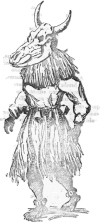
Expenses may dictate our destinations. I would like to take it to some key festivals, to include St. Croix, where that ‘bull’ character has largely been forgotten; but, where there are strong masquerade traditions still practiced. I would like to put it on in Frederiksted, St. Croix, exactly at the crossroads where it was once performed in front of the old Brow Soda factory. WW: Where else would you stage this - if you had your wishes? EL: I would like to take it to Antigua, where young people in the villages still have a sense of the jambull, as it is called there. I would like to see it produced in New York, where I wrote the original play, perhaps at an institution such as La Mama, ETC. at its Greenwich Village’s facility - World Theatre Institute. Certainly to Ghana - a tradition with which I am familiar - and where it is still practiced. That is why some elements of Ghana’s present-day practices are included at the end of our play. WW: In the best of all scenarios, where else would you take it? EL: Well, certainly to Denmark, whose cultural policy in Danish West Indian colonial times tolerated our dance traditions under its colonial policy, but at a stiff price. Let’s not forget Sweden. Certainly, if for no other reason: because of their generous support of Caribbean Theatre by engaging our perennial playwright, Derek Walcott. I cannot forget Denmark, and their appreciation of our own Virgin Islands’actor, Todd Duncan, performing in the traveling production of Gershwin’s Porgy and Bess – despite threats by the Nazis to burn down the theater, during World War II. |
 EL: Well, firstly, that fragments of our past – our societal past
– belong to the whole human story. Furthermore, however frail our
pasts may seem, – that is, however traumatic, or undervalued – they
are the preamble for deeper meanings, and celebrations. Besides, we all
possess elements which are potentially courageous and transformational,
despite the darkly passages of our personal existence. All this confirms
why it is better to collectively understand, and generate coherence from
these "lost" episodes in an otherwise inchoate world. Exile
exemplifies this uncertainty, and I have used a device of verse
juxtaposed by prose to elucidate the depths, and yet the commonplace, of
true exile – the exile of the spirit from our human experiences. There
are interactions between a shift from emphasis in the various bulls. I
hope this interplay gives a glimpse of these shards of historical
consciousness, understood by the dispossessed, the marginal and the
downtrodden in Caribbean society.
EL: Well, firstly, that fragments of our past – our societal past
– belong to the whole human story. Furthermore, however frail our
pasts may seem, – that is, however traumatic, or undervalued – they
are the preamble for deeper meanings, and celebrations. Besides, we all
possess elements which are potentially courageous and transformational,
despite the darkly passages of our personal existence. All this confirms
why it is better to collectively understand, and generate coherence from
these "lost" episodes in an otherwise inchoate world. Exile
exemplifies this uncertainty, and I have used a device of verse
juxtaposed by prose to elucidate the depths, and yet the commonplace, of
true exile – the exile of the spirit from our human experiences. There
are interactions between a shift from emphasis in the various bulls. I
hope this interplay gives a glimpse of these shards of historical
consciousness, understood by the dispossessed, the marginal and the
downtrodden in Caribbean society.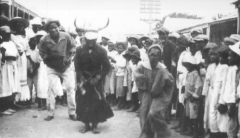 EL: Well, already it has energized some communities locally and
abroad to extend invitations to us.
EL: Well, already it has energized some communities locally and
abroad to extend invitations to us.