| WW: In The Killing of Arthur Sixteen, are there
any hidden features in the repertory, or theatrical gestures or props
– to which we should given special attention?
WW: How were you able to cast this play? EL: At first, I talked to many persons in my community: old and young. Then, my co-producer, Afreekan Southwell, went to New York, to see the exhibition of London-based artist Kieth Piper. (He was very important to us because of his Antiguan heritage transposed so powerfully in his ideology as an artist.) Southwell met Danny Knowles, another Antiguan designer, knowledgeable in the jambull tradition form our generation. (He designed the poster for our play, thankfully.) After he returned, he visited local heritage organizations and appealed to persons who knew about Arthur Sixteen. I contacted pageant and museum officials in Antigua. By then, we recruited persons who were peers of Arthur Sixteen, who knew his musicians. We spent a lot of time meeting and becoming grounded in all this lore, the subtleties of performance traditions, and styles of dance and mime. By then, those of us who had learned from these older performers, were matched against the bulls of our villages, to play those roles. WW: All this before you started rehearsals? EL: Oh yes. Then, I went back and re-read festival and pageant documents which I had collected over twenty years. I re-read the primary 1736 Antiguan Conspiracy, its trial documents – testimony, associative ‘rebellion’ events which it influenced, looking for common features. (I had written a film script, Cry From the Ravine, about this before; so, I had some grasp of the subject.) I also looked at my correspondence with David Gaspar, which was generated when he was writing his Masters, and later, his definitive book, Bondsmen and Rebels. Gaspar raised the possibility that the Ikem Dance and play which the Gold Coast captives in Antigua staged in a public pasture, may have been so convincing that it may have prompted the hysteria, which the trial found difficult to substantiate. WW: How important are the costumes in a masquerade play such as The Killing of Arthur Sixteen? What emphases do they provide – are they mostly visual, or do they lend nuances to the repertoire?
So these colors – they represent their cosmologies – elements of which survived and were exported – flagmen at the head of these early steel-drum bands, Signifiers who marched ahead of public funerals, who wailed publicly before hangings, and epic departures. These colors also denote spiritual characteristics exemplified by deities in the Kongo Atlantic cosmologies. Of these many horned masquerade traditions - the Crucian presence of "Paddy" and "Fresco", the 1878 Cuban Diablito, the Sansay horned masquerader of Dominica, the Bosou of Haiti, the Minotauro of Chiapas, the Jambull of Antigua, the Vejigante of Puerto Rico, and El Tio of Bolivia – ultimately, we will build these visual and dramatic elements in the play’s traveling revue. More importantly, this staging of The Killing of Arthur Sixteen, may, hopefully, re-establish a Virgin Islands tradition, since we generated a young dance troupe, Court of O-Ware, around our older musicians and jambull performers. They will participate in the St.Thomas Carnival’s Adult Parade this year. |
|
For more about the Playwright and the play>To Your Library...What's In It For You...Home Page |
|
To contact the Playwright email:edgar_lake@hotmail.com |
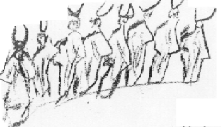 EL: Well, the style of the play’s dramatization is akin to
something perceived as conspiratorial – much like the 1736 Antiguan
Conspiracy, an Akan play performed in the pasture that belonged to Mr.
Otto. Later, it was used as the backdrop in a court trial against
Africans planning to blow up their "Masters" in a Guy Fawkes
annual dance. Every prop has a layered meaning: its traditional intents
( as best as I can determine), as well as its aesthetic content
(bringing new luster to our energies). The language is studded with a
vernacular for which we may have been the last generation to understand,
or have been governed by its consequences. Having the drama roam between
poetic verse and Creole prose, shows that I have not shied away from the
tension of these elements when placed in formal theatre, and its
dramaturgy. This is exactly what the spirit of Arthur Sixteen does,
roaming from village to village – our points of exile - or as our
elders would say, "from pillar to post".
EL: Well, the style of the play’s dramatization is akin to
something perceived as conspiratorial – much like the 1736 Antiguan
Conspiracy, an Akan play performed in the pasture that belonged to Mr.
Otto. Later, it was used as the backdrop in a court trial against
Africans planning to blow up their "Masters" in a Guy Fawkes
annual dance. Every prop has a layered meaning: its traditional intents
( as best as I can determine), as well as its aesthetic content
(bringing new luster to our energies). The language is studded with a
vernacular for which we may have been the last generation to understand,
or have been governed by its consequences. Having the drama roam between
poetic verse and Creole prose, shows that I have not shied away from the
tension of these elements when placed in formal theatre, and its
dramaturgy. This is exactly what the spirit of Arthur Sixteen does,
roaming from village to village – our points of exile - or as our
elders would say, "from pillar to post".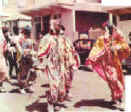 EL: In the play, the colors of the bull’s capes – they represent
the various guilds which existed in my time: artisans, woodsmen,
farmers, fisherman, butchers, porters, house-movers, carpenters,
hangmen, sewage porters. These people came from various neighborhoods,
and "families", clans – if you will. They had distinctive
vocabularies, dances, public sphere aesthetics, and world views. They
engaged the State – testimonies, and public acts: smuggling, and
police resistance, and hangings. (One horned masquerade was a hangman!
The ultimate masker, you see!)
EL: In the play, the colors of the bull’s capes – they represent
the various guilds which existed in my time: artisans, woodsmen,
farmers, fisherman, butchers, porters, house-movers, carpenters,
hangmen, sewage porters. These people came from various neighborhoods,
and "families", clans – if you will. They had distinctive
vocabularies, dances, public sphere aesthetics, and world views. They
engaged the State – testimonies, and public acts: smuggling, and
police resistance, and hangings. (One horned masquerade was a hangman!
The ultimate masker, you see!)