| WW: What about Off-Broadway - Was that arena affording a
glimmer of hope?
EL: Oh, sure! This florescence has to be understood against the earlier Black New York City theatre traditions. The earlier WPA-era Federal Theatre in Harlem, in which Orson Wells had participated. The post- Sixties Black Nationalist Theatre in which LeRoi Jones’ wrote, among others, The Slave. Barbara Ann Teer’s National Black Theatre; Black National Theatre Network where Novella Nelson worked to empower national black theater repertory. There was the Black Theatre Alliance with Peter Bailey and Duane Jones. Actress Frances Foster in the Joseph Papp’s Shakespeare-in-the-Park Festival’s DelacorteTheater, and Hazel Bryant’s Richard Allen Center for Culture and Art (at Lincoln Center) , which brought Nigerian National Theater Company’s Biko’s Inquest, and other Caribbean theatre companies to showcase in New York City. There was Theatre of Latin America, and later, Black Children’s Theatre on 42nd Street on Times Square. Later, I saw Derek Walcott’s Remembrance, with Roscoe Browne, at the Public Theater. I was a beneficiary of many of these circles. WW: So, New York City was a hotbed for Black Theatre aspirations? EL: Oh, sure. But, there were serious prices to pay, too. I remember Ed Bullins, the tragic death of his son while he battled for the authenticity of his play, The Taking of Miss Jane. There were other plays and their embattled playwrights, Lonnie Elder’s Ceremonies of Dark Old Men, which I first saw at the Morris Mechanic Theater in Baltimore, with Robert Guillaume. There was Joseph Walker’s The River Niger, and Charlie Russell’s Five on the Black-Hand Side. I remember Lloyd Richards working tables, while reading August Wilson’s scripts, which he later developed at the Yale Drama School. I can still see Master Percussionist Max Roach in the Henry Street Settlement Theatre's mezzanine, making last-minute adjustments to his score for Larry Neal’s last produced play, The Beautiful Monster Inside the Monstrous Blue Horn. I remember being introduced to Playthell Benjamin, the librettist, at the Ubu Theater, on a Saturday morning’s audition. And also being able to see my first opera Treemonisha, at the City College's Davis Theater. South African producer, and Hunter College student Duma Ndlovu with Woza Albert, and later Bopha. WW: The joint was jumping, wasn’t it? But, there were real consequences for every success story. EL: Many artists were being imprisoned in Latin America, and Africa, and parts of Europe. It is important to remember that the societies which persecuted them - suffered tragically, and violently as well. So many musicians, writers, athletes, actors – perished while completing their work. I realized the mortality of being an artist. Alienation and exile seemed to force us all to urgently write what we knew, since what you knew was at risk from the colonial order, our changing worlds, and the new modern art movements. There were filmmakers in Latin America who were ‘disappearing’ – students I knew who studied at City College film department - who died under one junta, or another.(In fact, the first organization I joined in New York City was The Committee to Defend Latin American Filmmakers) WW: Can a play about a forgotten masquerade tradition - one that was once danced in early Frederiksted, as well – still secrete something essential to our time? EL: Well, this opportunity makes rescuing this past heritage even more sobering! Will its lessons of an endangered heritage stand the test of time? And then, can it do so - not only against external forces, but internal forces? I don’t know! Is there a lesson in the recent depreciation of young lives in this territory? Perhaps. How is one simple, courageous life demonstrated as having immense value? – Does the time of a past masquerader’s sacrificial life have the insouciance – the pluck – to speak to us? Can we still rhapsodize the essence of our lives? Or, do we merely exploit culture, in this time, and in this place? That’s what this play now asks of all of us who are involved with its reproduction: both the cast members and the audience. WW: Exactly. Well now, further trace that possibility on our template for us.
speaks to a lost tradition in these Virgin Islands, as well. So producing it here, provides for me, a special feeling of gratitude – giving something back to a community that also helped prepare me for a complex world. But, beyond this gesture of restoration, it allows many persons who share this cultural memory, both cast members and audience, to participate again in a significant part of our cultural lives . This, I can assure you, is not available on the Travel Channel, or the National Geographic Channel. |
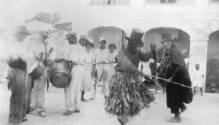 EL: This
version of the play – (because it is an abbreviated version for this
one-night performance) –
EL: This
version of the play – (because it is an abbreviated version for this
one-night performance) –