| WW: I know that you have been working at the details
of this production for a while. What features may lend insights to
critical areas of engagement – your particular repertory style, the
formalization of costumes, the dramaturgy – how might this engage your
particular scholarly audience?
So, bringing these folk elements to a formal theatre production has challenges – in the folk representation; narrative structure, dramaturgy, aesthetics, and elliptical discourse. That is a challenge, and hopefully, a cultural strength. Because of an audience that is "knowledgeable" – both folk, and the "scholar/experts" - a masquerade play like this can be a rare opportunity to explore this as formal drama. Outdoor festivals bend obvious lines of demarcation, or boundaries. But, in the theatre tradition, these parameters are more universally accepted. There are rules, and boundaries, and you engage – even experiment - at your own risk. WW: What is actually meant by the title of your play, The Killing of Arthur Sixteen?
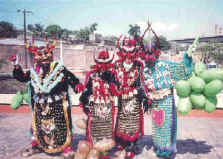
Finally, the particular Antiguan term, killing, was one we heard very early. It is a term of ambivalence, sometimes used to express an aesthetic of the excess. Whether it is to express some bounty, some act of punishment or praise – as in expressing lavish sentiments of this masquerader’s passing – it demonstrates this killing aesthetic. There are other elaborations: "Killing" may well have evolved from the charcoal vendor's practice. After all, the last small fragments of the coal from the coal kiln was called "killy-killy". These small broken pieces, at the end of a barker's day activities – reserved for those too deeply involved with the gossip of the marketplace, or the street-life; this was the last chance to salvage one's reputation,– or save a spouse – otherwise "killed" by the tardily prepared dinner. This vendor language, persuasive and sanguine, was the final flattery and warning – a "killy-killy", the epitome of late hour flattery; redemption gleaned by the fingers of the desperate from the black sparkling coal-dust. |
 EL: I
remember reading Judy Stone’s book on West Indian Theatre, and
being struck by her model of analysis of Japanese theatre traditions –
the Noh, The Kabuki - and I might add - the Butoh. Stone seems to throw
down the gauntlet –West Indian Theatre, so mimic-ridden in its bid for
legitamacy, has forsaken its folksian strengths, losing any serious bid
for classic elements towards a national theatre tradition. This reminds
me of an earlier paper by Walcott ( I believe the title is Meanings),
where he talks about watching Japanese films on his first trip to New
York. Walcott felt strongly that the woodsmen of his childhood had an
unclaimed classical presence, much like Japanese warriors.
EL: I
remember reading Judy Stone’s book on West Indian Theatre, and
being struck by her model of analysis of Japanese theatre traditions –
the Noh, The Kabuki - and I might add - the Butoh. Stone seems to throw
down the gauntlet –West Indian Theatre, so mimic-ridden in its bid for
legitamacy, has forsaken its folksian strengths, losing any serious bid
for classic elements towards a national theatre tradition. This reminds
me of an earlier paper by Walcott ( I believe the title is Meanings),
where he talks about watching Japanese films on his first trip to New
York. Walcott felt strongly that the woodsmen of his childhood had an
unclaimed classical presence, much like Japanese warriors.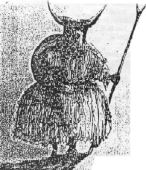 EL: First, an understanding - that sometimes, before a great
definition may come a perilous trauma. The play, The Killing of
Arthur Sixteen, is based on my own experience about a childhood
masquerade tradition, and the threat to its cultural meaning in my
life-span. This masquerader, Arthur Sixteen, was the actual title of a
real person. In the 1970s, he was mistakenly reported as dead to many of
my generation, living abroad during a very anxious political time. It
was significant cultural news to us.
EL: First, an understanding - that sometimes, before a great
definition may come a perilous trauma. The play, The Killing of
Arthur Sixteen, is based on my own experience about a childhood
masquerade tradition, and the threat to its cultural meaning in my
life-span. This masquerader, Arthur Sixteen, was the actual title of a
real person. In the 1970s, he was mistakenly reported as dead to many of
my generation, living abroad during a very anxious political time. It
was significant cultural news to us.