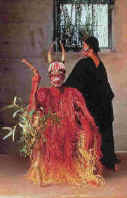
WW: How did news of this masquerader become a play – was he really killed?
EL: I had gone to see my first production of Antigone with a
childhood friend, and painter/poet, Hugh Burton. We saw a remarkable
actor in New York named Arthur Burkhardt, best known for his portrayal
of Frederick Douglass. What left an indelible impression on me was Creon’s
choices. Weeks after, when I was confronted with the purported death of
my favorite childhood masquerader, I felt a thread had been broken. I
was desperate to record his life - as my cultural life. Many years
later, after writing the play, I learned that it was another masquerader,
Pharoah, who had been set on fire! That’s the version of the play now
under production. Several other masqueraders were set afire over the years,
and in several islands, the tradition was suspended over these tragic
events.
WW: So, the term, "killing"- as supposed to,
"the death of " –is pretty discriminating in the title of
your play.
EL: Absolutely! At first, imagining how this masquerader had been
killed, caused a sharp pain of separation and finality. But, something
else was signified beyond the fact that a great tradition of my
childhood had been desecrated. A paradox had occurred: it occurred to me
that his death was not as haunting as was the meaning of
his life: until his death, the gradual marginality of his life’s work
had been accepted as inevitable. Set aflame, the faster he ran, the
faster he was consumed.
So I felt that underscoring the killing, the slow process of
this masquerader’s marginality, of this man’s presence - this dying
tradition – particularly as I then felt it, being cut off from my own
indigenous cultural pageants – that play was my statement. But, too,
the frustration of learning of his demise, someone so vital,
through word-of-mouth accounts; his death was something overheard at functions,
gatherings – these shards of one’s past, one’s identity were, I
realized, a terrible confrontation for which no one had prepared me.
On another level, Arthur Sixteen’s legacy: roaming from village to village,
from village to town represents an internal exile, within a country and
within oneself. Just as swiftly as we had been tutored to run off, Arthur
Sixteen’s stewardship had been consumed by our narcissism for "a
better life".
I began to understand this in my own life, my own circumstances, and
in my own region’s literature, and the collective history and
literature of my hemisphere. So, the exiled "I" one hears
portrayed in the play’s verse, contrasted with the story-tellers’
prose of the masquerader’s ‘deep’ cultural life, is a struggle
between the first person "I" and the Second Person plural
"You". [I have posted a more critical paper, Bulls
and Allusions: Text and Performance in the play: The Killing of Arthur
Sixteen].
WW: How does an artist gestate so complex a series of events?
EL: Well, you are inevitably prepared for it, really. Your particular
circumstances, your privileges, your opportunities, your failures, your
misfortunes sensitizes your existence. This loss of Arthur Sixteen, has
embodied all my losses; it is true. Then, however, given my growing
awareness about my heritage, it also underscored my prideful identity.
So, I wrote the play as part of a trilogy, Three for the Homeland.
WW: Is this earlier version of the play - the same one that you are
producing?
 EL:
More or less. Visiting the cemetery in Antigua some fifteen years after
I wrote the original play, on what I perceived was a meaningful
pilgrimage, I learned from the cemetery workers that Arthur Sixteen was
still alive. They assured me that this mistaken identity was a typical
experience among immigrants who had left for some time. But, the
original play, written in Harlem, was undoubtedly shaped by the social
and political life of Antigua of the 1970s. I was also living the
political consciousness of the African Americans’ struggle, coupled
with the emergence of Caribbean Nationalism. It was a tempest I can only
now decipher.
EL:
More or less. Visiting the cemetery in Antigua some fifteen years after
I wrote the original play, on what I perceived was a meaningful
pilgrimage, I learned from the cemetery workers that Arthur Sixteen was
still alive. They assured me that this mistaken identity was a typical
experience among immigrants who had left for some time. But, the
original play, written in Harlem, was undoubtedly shaped by the social
and political life of Antigua of the 1970s. I was also living the
political consciousness of the African Americans’ struggle, coupled
with the emergence of Caribbean Nationalism. It was a tempest I can only
now decipher.
For instance, I remember meeting an African American female sculptor,
Valerie Maynard, my first day in Harlem. The Studio Museum of Harlem was
just starting its Artist Residence program. She introduced me to Leroi 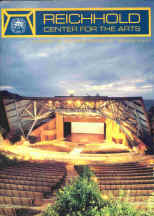 Clarke from Trinidad. Later, Valerie became the first curator of the
African sculptural arts collection at The Reichhold Center for the
Performing Arts. During that first residence in Harlem, I also met a
Studio Museum of Harlem intern, the late Crucian artist Charles Abramson.
He was a beautiful mentor: father, teacher, sculptor, painter, actor,
priest. [There is a line in my play for him: "When we heard of
your death, we believed it! For, we see in it the hope of
another."]
Clarke from Trinidad. Later, Valerie became the first curator of the
African sculptural arts collection at The Reichhold Center for the
Performing Arts. During that first residence in Harlem, I also met a
Studio Museum of Harlem intern, the late Crucian artist Charles Abramson.
He was a beautiful mentor: father, teacher, sculptor, painter, actor,
priest. [There is a line in my play for him: "When we heard of
your death, we believed it! For, we see in it the hope of
another."]
Continue>