| Our paraders begin at the cemetary, sometimes visiting a
loved one’s grave, transforming their heartfelt sentiment – and
march up the street playing and dancing to polyrhythmic musics,
providing joy for countless others. Who are they? Squires dance
alongside some teenage Ninjas, both real and imaginary. Yet, through all
these seeming disparities, our veterans of Gulf Wars, European, African
and Middle Eastern immigrants, all generate particular insights for their own
groups along the route; identifying real and perceived elements of
Yoruban, Catalan, Cantonese, Fillipino, Syrian and Georgian narratives
(gestures, spatial incongruities, aesthetic burst, déjà vu, etc) in
our syncretic Carnival forms.
I, for instance, have experienced the Hugga Bunch troupe, and most recenty Gypsies transform real-life commemorative tragedies into completely fictive experiences – passages of sequinned and plumed movement – as excerpts from say, Wilson Harris’ novel, The Palace of the Peacock. I have felt the aural intensity of say, The Rising Stars Steel Orchestra, transforming a tiresome crowd into the vortex of Earl Lovelace’s novel, The Dragon Can’t Dance. And there are particular crossroads where these fictive narratives are performed, over many generations! Again, I have experienced this powerful agency of fraternal kinship, at the Lincoln Elementary School’s wall - where the first steel bands paused in the early 1920s, taking in part of the first St. Thomas carnival. These first "steeelbands", Casa Blanca, and Hell’s Gate steelbands paused in the middle of some musical interlude, resolving at this very Lincoln School (now Antonio Jarvis Elementary School) corner. Why? Because this was perceived as an idealized boundary, a network of ascending steps, side-winding alleyways and descending gullys. Here, at a place named after Abraham Lincoln, these band's rhythms stopped; posting their musical energies by returning in "island friendship" – over the span of some years later and teaching the first steelband melodies and techniques to the native students of these islands. Out of this muscial nativity came doctors, governors, scholars and bishops. WW: The ACASA website reveals some high-powered Multi-media presentations and papers will be delivered against the backdrop of our Carnival. Could this be this possibility of a new "nativity" of engagement? EL: Absolutely This is a new kind of commentary within our Carnival Time. Fresh scholarly discourse and commentary will be generated, and may well be recorded as a part of the 21st century's modern Carnival traditions. No doubt, there will be some fairly vigorous matters raised by these ACASA scholars. Generating a triennial at this time, can illuminate, define and even transform conventional tools of research and perceptions. One scholar, for instance, will examine how Caribbean artists - living outside their communities - participate, and impact on these various Caribbean festival conventions and forms. WW: What is your participation in the 12th ACASA Triennial, and how does it impact on the Carnival?
|
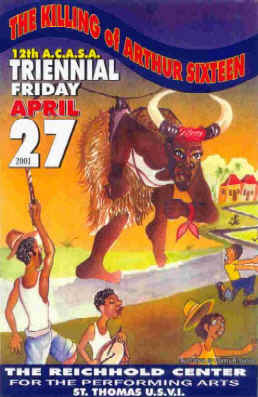 EL: I opted to produce this play – a masquerade play – on stage.
Its forms may well subvert conventional Carnival masquerade discourse.
We are sponsoring a young dance troupe with our traditional musicians in
the carnival’s Adult Parade, What may be proven as exportable – be
it social principles of the masquerade tradition, or the
transformation of esthetic elements, levels of discourse may be distant
and elusive dynamics which our university’s cultural students, may
help determine. For instance, they may detect levels of a more venerable
debating tradition. They may also detect a sense of the elusive ‘authorship’
which musicians, and calypsonians share--not to mention this masquerade play
produced during
our elusive "Carnival Time". They may hear verse that
heightens their appreciation for the rising voices of their new poets
– three come to mind: Habib Tiwoni from St. Thomas, living in New
York; his last volume, Islands of My Mind. But, there is also
David Weeks from St. Croix, surviving cerebral palsy, who lives in
Maryland; his latest volume is called Ancient Traditions. And,
there is Rudy Wallace, whose poem, Lady with the Red Dress, was
recently anthologized in One Hundred Best Poems of North Carolina,
and now Leon Symister, with his volume, From the Depths of My
Soul.
EL: I opted to produce this play – a masquerade play – on stage.
Its forms may well subvert conventional Carnival masquerade discourse.
We are sponsoring a young dance troupe with our traditional musicians in
the carnival’s Adult Parade, What may be proven as exportable – be
it social principles of the masquerade tradition, or the
transformation of esthetic elements, levels of discourse may be distant
and elusive dynamics which our university’s cultural students, may
help determine. For instance, they may detect levels of a more venerable
debating tradition. They may also detect a sense of the elusive ‘authorship’
which musicians, and calypsonians share--not to mention this masquerade play
produced during
our elusive "Carnival Time". They may hear verse that
heightens their appreciation for the rising voices of their new poets
– three come to mind: Habib Tiwoni from St. Thomas, living in New
York; his last volume, Islands of My Mind. But, there is also
David Weeks from St. Croix, surviving cerebral palsy, who lives in
Maryland; his latest volume is called Ancient Traditions. And,
there is Rudy Wallace, whose poem, Lady with the Red Dress, was
recently anthologized in One Hundred Best Poems of North Carolina,
and now Leon Symister, with his volume, From the Depths of My
Soul.