| These individual acts of masquerade as marronage,
done for years, span all social and gender stratas. Then there is the
constant counter-parade, a double stream – what I call the
"Orpheus jetstream" - where performers who have completed the
parade route, walk back against the parade, in front of the bystanders.
This is very textured, and shifts the Carnival epicenter, from one space
to another.
WW: How may you elaborate on that term "islands of
spectators"?
 EL: By that I mean, Africans and Caribbean peoples live here, poised
across socio-religious lines. Jews and Arabs peaceably live here – yet
their stories and music remain underground. Europeans, Asians and
Orientals live here, too. At the anterior level of the Carnival,
families and other social groups have perceived "favorite
places" along these routes; this is taught very early –across
generations. From these junctures people observe through others, the
entire carnival experience. For many years, even generations, they
encounter images, sounds, affirmations, re-unions of cultures at these
particular places. People often overhear commentaries – highly
personal experiences which inform their particular lives. This has
nothing to do with any input from the Carnival Committees, their judges,
local radio and television commentators. Families go to the park, share
these spaces – food, timid introductions to each other, informal bonds
are formed, sometimes various countenances are established with, say,
toddlers and older faces – and the Carnival as a national cultural
pageant is witnessed, realized and mobilized from these kinds of
traditional spaces. EL: By that I mean, Africans and Caribbean peoples live here, poised
across socio-religious lines. Jews and Arabs peaceably live here – yet
their stories and music remain underground. Europeans, Asians and
Orientals live here, too. At the anterior level of the Carnival,
families and other social groups have perceived "favorite
places" along these routes; this is taught very early –across
generations. From these junctures people observe through others, the
entire carnival experience. For many years, even generations, they
encounter images, sounds, affirmations, re-unions of cultures at these
particular places. People often overhear commentaries – highly
personal experiences which inform their particular lives. This has
nothing to do with any input from the Carnival Committees, their judges,
local radio and television commentators. Families go to the park, share
these spaces – food, timid introductions to each other, informal bonds
are formed, sometimes various countenances are established with, say,
toddlers and older faces – and the Carnival as a national cultural
pageant is witnessed, realized and mobilized from these kinds of
traditional spaces.
WW: So, somehow other levels of the Carnival experience are played
out?
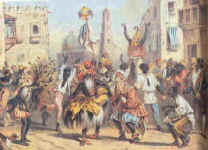 EL: Absolutely. There are nominational colors – Kongo
Afro-Atlantic, and Caribbean Basin colors, classic regional rhythms, –
resurgences, predominations, unique postings of these visual
vernaculars, for instance - not noticed by the official observers. There
are unique cultural agencies which are often generated, reveries where
the sane and the insane merge – these are the bedrock registries of
place names, transfers of family names (and nick-names), titles,
rational and irrational behaviors which demarcate neighborhoods,
mythical boundaries and zones. There are shifts of engagement,
popular "nations" and fabled themes – both contemporary and
traditional – which are played out in the eyes of the community. EL: Absolutely. There are nominational colors – Kongo
Afro-Atlantic, and Caribbean Basin colors, classic regional rhythms, –
resurgences, predominations, unique postings of these visual
vernaculars, for instance - not noticed by the official observers. There
are unique cultural agencies which are often generated, reveries where
the sane and the insane merge – these are the bedrock registries of
place names, transfers of family names (and nick-names), titles,
rational and irrational behaviors which demarcate neighborhoods,
mythical boundaries and zones. There are shifts of engagement,
popular "nations" and fabled themes – both contemporary and
traditional – which are played out in the eyes of the community.
WW: Incredible. Give me an example, Lake!
EL: Imagine, these highly charged spaces, studding the parade routes,
where say, seniors citizens who have "read" such historical
groups, say, as the Zulus, and more recently the Gypsies,
and the Indians.
These troops all have social and historical narratives, "nations", and
associations with events and even real families in the community. Then,
there are veteran individual entrants, like Mr. "Cherry"
Bonnelli, with his Chaplinesque performance texts spanning some thirty
or forty years in St. Thomas Carnival performances; lately, Dr.
Gilbert Sprauve has been extending this Kongo tradition, chronicling
their empirical parodies. |