|
|
Your Library...What's In It For You... |
|
An Interview with Edgar Lake by Wallace Williams March 2001 |
|
Playwriting in a ForgottenTradition: In their July/August newsletter, the Arts Council of the African Studies Association (ACASA) promotes their triennial convening in April, in St. Thomas, during Carnival. There is also mention of Virgin Islands poet/playwright, Edgar Lake, producing his play, The Killing of Arthur Sixteen, for the ACASA audience, on April 27th, 2001 at the Reichhold Center for thePerforming Arts. Their website, http://itsdev.appstate.edu/triennial carries their agenda, and the scholars’ tentative triennial titles.
|
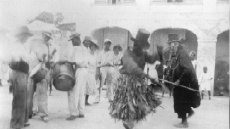 WW: Here we go again, Lake. ACASA is coming to St.
Thomas, a first – just as UNESCO first came here in St. Croix merely
three years ago. WW: Here we go again, Lake. ACASA is coming to St.
Thomas, a first – just as UNESCO first came here in St. Croix merely
three years ago.
EL: Yes. ACASA’s 12th Triennial – first of this millennium – has chosen St. Thomas as its host site. The University of the Virgin Islands is its host organization, with Dr. Robert Nicholls as the local ACASA liaison. Their week-long symposium will be held at Frenchman’s Reef Hotel, with many activities provided alongside the St. Thomas Carnival festivities. WW: From our Virgin Islands perspective, what makes their visit here particularly significant?
WW: Give us an example of their influence. EL: ASA once submitted successive annual nominations for Wole Soyinka, the first Black African awarded the Nobel Prize for Literature. WW: Who are some ACASA members – and what of their scholarship - that we should be particularly aware? EL: Well, there is Robert Farris Thompson, John Nunley and Judith Bettelheim. Their areas of expertise are in the philosophies of African and African American Arts, Afro-Atlantic Kongo Arts, |
|
|
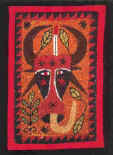 EL: Many Caribbean Basin arts are staging a transformation in the
Virgin Islands. Here, there’s a rich masquerader aesthetic,
"Those who feel it, know it". On the first swing of the 21st
Century pendulum, the Virgin Islands seem to be vibrating – and as a
veritable tuning fork on the Kongo Atlantic Arts proscenium –
participating in the new cultural order. ACASA has an impressive array
of scholars! ACASA membership spans Europe, Asia and North America. What
I know of African Studies Association (ASA), and its Arts Council (ACASA),
is that they are among the most influential of scholarly groups in the
United States. ASA, the umbrella organization, wields enormous expertise
and resources among its membership, particularly in regards to the
leading art publishers, and internationally commissioned projects on
African art scholarship.
EL: Many Caribbean Basin arts are staging a transformation in the
Virgin Islands. Here, there’s a rich masquerader aesthetic,
"Those who feel it, know it". On the first swing of the 21st
Century pendulum, the Virgin Islands seem to be vibrating – and as a
veritable tuning fork on the Kongo Atlantic Arts proscenium –
participating in the new cultural order. ACASA has an impressive array
of scholars! ACASA membership spans Europe, Asia and North America. What
I know of African Studies Association (ASA), and its Arts Council (ACASA),
is that they are among the most influential of scholarly groups in the
United States. ASA, the umbrella organization, wields enormous expertise
and resources among its membership, particularly in regards to the
leading art publishers, and internationally commissioned projects on
African art scholarship.